Phlebotomists have a tough job. You deal with a wide range of issues, including helping patients feel safe and comfortable so you can get samples to the lab. The challenges increase when you deal with infants. These tender young patients can’t speak, don’t understand what’s going on and sometimes have hard-to-find veins. After a challenging personal experience, Caresfield’s Key Account Manager Marcela Gallo implores you to go beyond pediatric blood draw guidelines to provide the best possible care.
One of the easiest ways to provide exceptional care when drawing blood on an infant is to have appropriately sized tourniquets. While World Health Organization best practices recommend having a tourniquet, that’s like recommending a carpenter have a screwdriver. Yes, a screwdriver is an important tool used in many applications, but there are 14 different types to choose from.
A standard adult tourniquet is 1-inch-by-18-inches. It’s a great size that works for a lot of patients. While this size is often perfect, is it always right to use an adult-sized product for an infant? What if the only hospital robes available were adult-sized? Imagine the safety risks if you had to put an infant in a full-grown robe. Or the dangers associated with cutting an adult size down to fit a baby. If there is an acceptable product for infants on the market, don’t you owe it to your patients to see how it works?
The Wrong Tool for the Job
Pediatric tourniquets are a passionate topic for Marcela. The mother of a 10-month-old in Los Angeles County, Marcela recently took her son to the emergency room for RSV. He was sick, dehydrated and wasn’t eating. He needed an IV.
The staff did a great job following proper guidelines1 with two registered nurses working together to start the IV. They started with the right arm but couldn’t find a vein with the first two pokes. As a result, they decided to try the left arm.

At that point, one of the nurses took the adult-sized tourniquet, folded it and cut it down to a smaller size. Using an appropriately sized tourniquet made it much easier to find the vein. On the left hand, they found a viable vein on the first try.
“I asked the nurse why he cut the tourniquet,” Gallo said. “He said sometimes a smaller tourniquet makes it easier to find the vein and start the IV.”
After the initial struggles, it was good to have the IV going. Unfortunately, Marcela’s son had to be transferred by ambulance, and they did not run the IV during the transfer. By the time he settled into the new hospital, the original site had clotted, and they had to start over again.
13 Failed Attempts
It didn’t get any easier the second time around, even though nurses continued to follow pediatric blood draw guidelines. The new nurses made several attempts, but each time they inserted the IV and did a flush, it would pop out.
“As a mother, it’s a horrible situation,” Gallo said. “I kept my composure because I know the importance of an IV, but how long do you let them torture your child?”
The nurses called a team to insert a peripherally inserted central catheter (PICC) line. Even while running a wand over his arm to find larger veins, they still couldn’t find an acceptable option. In all, Marcela’s son was poked 13 times and suffered significant bruising. Each time, the new hospital used an adult-sized tourniquet.
A Hopeless Feeling
Even though she has worked for Caresfield for years and is aware of our specialty tourniquets, Marcela felt hopeless. Her son received care through a large, well-known health system. She knew the nurses were well-trained, and she found it difficult to suggest using a smaller tourniquet.
“How do you tell a PICC team to cut the tourniquet or try something else? It’s their job,” Marcela said. “After we got home, I reached out to the phlebotomy lab team and asked if having the right-sized tourniquet could make it easier to find the vein. They said yes, it could have helped.”
Moving Beyond Pediatric Blood Draw Best Practices
We know that phlebotomists are well-trained and hard-working healthcare professionals. If you work with infants but your training typically used standard adult-sized tourniquets, we encourage you to try a free sample of our infant tourniquets. We hope they will help you improve patient safety by making it easier to find veins and go beyond pediatric blood draw guidelines.
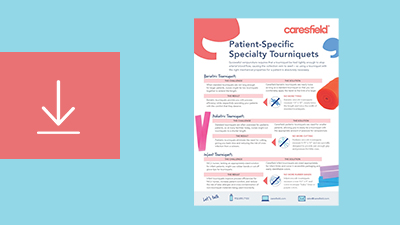
Check Out our Guide on Specialty Tourniquets
Caresfield offers smooth, non-latex pediatric tourniquets in purple and blue, packed in flat packs. We have local and national agreements with several group purchasing organizations. If your corporate purchasing office doesn’t see the value in properly sized tourniquets, you may be able to order at the facility level. Once you’ve seen the difference pediatric tourniquets make, you can make a convincing case to your value analysis team.
If you’d like to learn more, check out our blog post, Specialty Tourniquets Ease Pressures of Phlebotomy, or our YouTube video Disposable Tourniquets 101:
Sources
WHO Guidelines on Drawing Blood: Best Practices in Phlebotomy, World Health Organization, 2010, https://www.ncbi.nlm.nih.gov/books/NBK138647/, accessed Nov. 20, 2012