In the world of blood and tissue banking, there is no such thing as a “small” detail.
We often talk about the big-picture goals: domestic supply chain resilience, regulatory compliance, and donor retention. But for the teams on the floor, the phlebotomists, the lab techs, and the logistics coordinators, the success of the mission often hangs on a three-cent piece of adhesive or the tactile feel of a tourniquet.
As Caresfield prepares for the BCA 2026 Supplier Networking Conference, we’re looking past the catalog numbers to the actual human workflows they support. Because in this industry, “good enough” supplies are never actually enough.
The “Invisible” Friction: A Day in the Life
Imagine a typical Tuesday at a high-volume donor center. Your team is moving fast. A phlebotomist reaches for a cohesive bandage, but the roll doesn’t tear cleanly. A lab tech pulls a specimen from cold storage, only to find the barcode has flagged edges, making it unreadable by the scanner.
On their own, these are “minor inconveniences.” But in a high-stakes clinical environment, these moments are friction points.
- The Cost of a Workaround: When a product is inconsistent, staff develop “hidden” habits to compensate. They double-wrap. They tape over labels. They “make it work.”
- The Chain Reaction: Friction at the collection point creates a ripple effect. A poorly labeled tube in the field becomes a documentation nightmare in the lab and a potential safety risk in the supply chain.
At Caresfield, we don’t just see a box of supplies; we see the operational confidence of your team.
The Anatomy of a Reliable Workflow
Consistency isn’t a preference; it’s a clinical requirement. Here is how Caresfield looks at the categories that keep your facility moving:
1. Labels: The “Identity” of the Mission
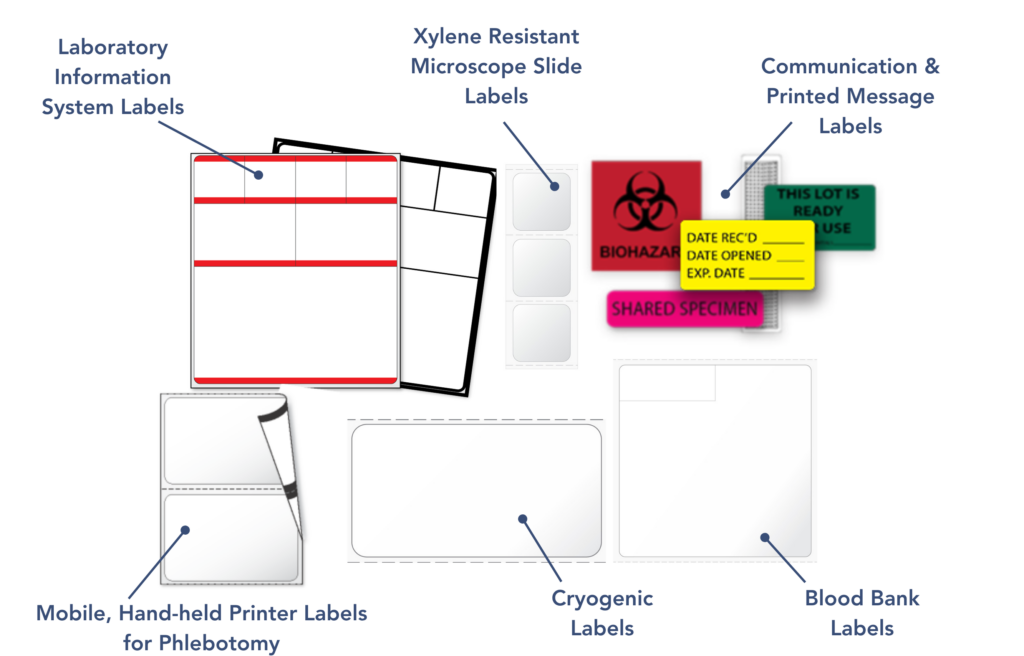
A label is more than paper and ink, it is the digital link between a donor and a patient. In the high-stakes environment of a blood bank, that link must be unbreakable and globally understood. This is why ISBT 128 certification isn’t just a regulatory checkbox; it’s a critical component of patient safety.
At Caresfield, we understand that a label failure in the cold chain is a data failure for the mission. That’s why our blood bank labels, and the high-performance adhesives that power them, are fully ISBT-certified. We ensure that from the moment of collection through ultra-low-temperature storage, your barcodes remain crisp, your adhesives remain bonded, and your facility remains compliant with the highest global standards for blood component identification.
- The Problem: “We spent three hours relabeling units because the last batch wouldn’t stick to cold glass.”
- The Caresfield Approach: We help you audit the environment first. Is it cryogenic? Is it humid? We match the science of the adhesive to the reality of your storage.
2. Phlebotomy & Collection: The First Impression
For a donor, the phlebotomy supplies are the only physical touchpoint they have with your organization. For the staff, these are the tools they use hundreds of times a day.
- The Problem: “Our staff is frustrated because the latest shipment of tourniquets feels ‘flimsy’ and inconsistent.”
- The Caresfield Approach: We focus on standardization. By ensuring your high-volume consumables feel and perform exactly the same every time, you reduce staff “decision fatigue” and keep the focus on the donor.
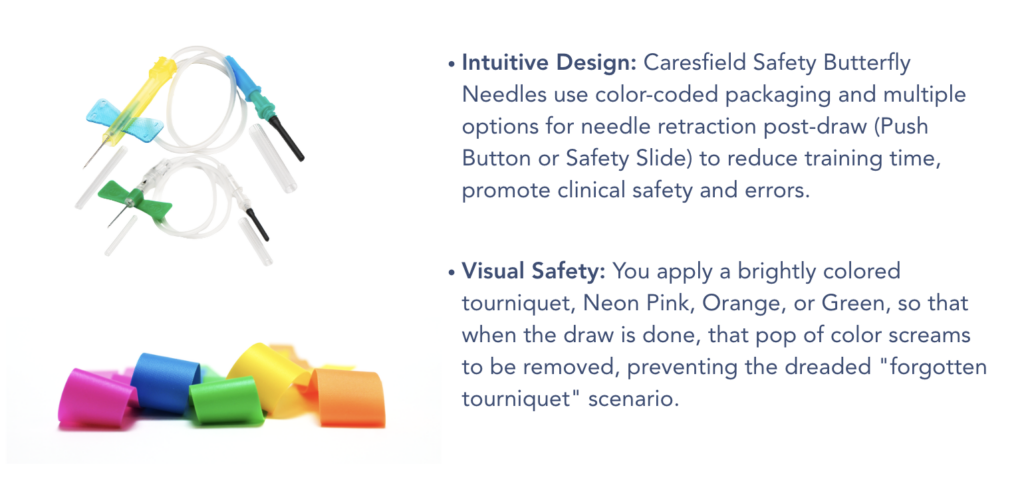
Caresfield tourniquets and blood collection products are available on Vizient MS1507 and Premier PP-LA-695.
3. Post-Collection: The Final Donor Touchpoint
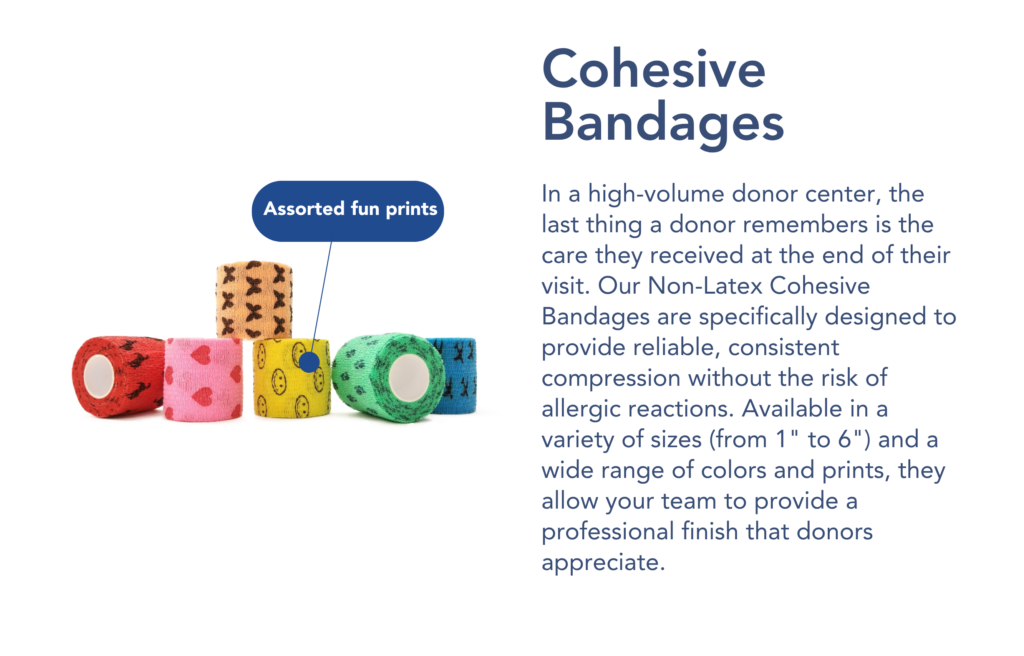
The collection is successful, the unit is secure, but the donor’s experience isn’t over yet. The last thing a donor feels is the wrap applied to their arm. This is a small detail that carries significant weight for donor satisfaction and safety.
- The Problem: “Donors with skin sensitivities are a growing concern, and using ‘standard’ wraps can lead to discomfort or allergic reactions. Plus, if a bandage doesn’t maintain consistent tension, it risks the integrity of the collection site once the donor leaves.”
- The Caresfield Approach: We advocate for the Non-Latex Cohesive Bandage as the gold standard for post-collection care. By standardizing to a high-quality, non-latex wrap, you eliminate the risk of allergic reactions while providing a reliable, self-adhering tension that stays secure without sticking to skin or hair. It’s a small investment in a donor’s comfort that ensures their final memory of the donation is one of professional, high-quality care.
The Hidden Tax of “Small” Problems
“Supply chain friction” is a polite way of saying “wasted time.” When you choose a domestic partner like Caresfield, you aren’t just buying products; you are reclaiming the time your team spends on the following:
- Compromised Traceability & Redraws: A smeared or peeling label creates a gap in the unit’s history. Quality supplies eliminate errors at the source, preventing costly redraws and ensuring every donation meets the rigorous standards required for patient care.
- Chain of Custody Integrity: ISBT 128-certified labels ensure that the digital link between donor and patient remains unbroken, even in ultra-low temperature storage.
- Operational Consistency: Standardizing high-volume consumables, like non-latex cohesive bandages, reduces staff “workarounds” and ensures a predictable, professional experience for every donor.
- Supply Chain Resilience: Leveraging domestic manufacturing and stable stocking levels removes the “friction” of backorders, keeping your facility focused on the clinical mission.
Let’s Start the Conversation (Before we meet in Universal City)
The BCA 2026 Supplier Networking Conference (May 18-19) is a fantastic time to connect in person at the Sheraton Universal. But your workflow challenges don’t wait for a conference date.
We want to prove our reliability to you before we ever shake hands in California.
Our invitation to BCA Members:
Don’t take our word for it; test the products in your own facility under your own “stress tests.”
- Step 1: Identify your biggest “friction point” (is it a label that won’t stick? A bandage that’s too expensive?).
- Step 2: Request a curated sample kit from Caresfield.
- Step 3: Let’s meet at BCA 2026 to discuss the results and build a workflow solution that actually fits.