Human touch is a constant part of quality care across all healthcare settings. While wearing proper personal protective equipment (PPE) for contact precautions is essential for all healthcare workers, controlling the spread of infections is especially important in long-term care settings. Patients and residents in nursing homes, assisted living and skilled nursing facilities may be particularly vulnerable.
The Centers for Disease Control and Prevention recommends wearing exam gloves when it can be reasonably anticipated that contact with blood or other potentially infectious materials, mucous membranes, non-intact skin, potentially contaminated skin or contaminated equipment could occur1. That means your caregivers should wear gloves for services like oral care, diabetes care and toileting. With nursing home doctors and therapists facing a 4.4 percent pay cut from the Centers for Medicare and Medicaid Services next year2, managing costs will be especially important.
With a variety of options available on the market, this post looks at different gloves you can consider for your non-acute facility.
How Many Gloves Do You Need?
Depending on the size of your facility and the number of departments wearing gloves, the exact number you need may vary. One of our nursing home clients in Minnesota uses 25 cases of nitrile and seven cases of latex gloves each month. That’s nearly 400 cases per year.
What Kind of Gloves Do You Need?
For most healthcare workers, the best type of gloves is a personal choice. There are three main types available: nitrile, vinyl and latex. We take a look at all three options in our ultimate gloves buyer’s guide.
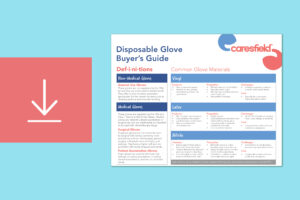
Our Glove Buyer’s Guide looks at the differences between nitrile, latex and vinyl gloves and their application across healthcare settings.
Many long-term care facilities use vinyl gloves because they tend to be cheaper. That’s not always the case, however. For example, we recently helped a nursing home in Connecticut upgrade their gloves to nitrile at a lower total cost. To help you make the right choice, we looked specifically at the differences between latex and nitrile gloves in a recent blog post.
While latex gloves used to be incredibly popular in healthcare settings, many facilities have moved away from them because to latex allergies. Due to repeated exposure, healthcare workers are at the highest risk of developing latex allergies. Learn more about the causes, symptoms and prevention of latex allergies on our blog.
Next, let’s evaluate the options based on different departments.
Clinicians and Caregivers
For team members providing physical care to residents, nitrile gloves are often the best PPE for contact precautions. Our nitrile gloves are thin and stretchy but incredibly durable. Phlebotomists like nitrile gloves because they can feel the vein. Chemo-rated nitrile gloves are also popular in hospitals because they are often as affordable as less-protective gloves.
It’s important to consider quality for caregivers working with residents or dealing with potential contaminants. Caregivers change gloves often. If you use a low-quality glove that rips or requires double-gloving, it could have a significant impact on your bottom line. In addition, nitrile gloves offer more protection than latex gloves.
Pharmacists
If your facility has a pharmacist on staff, they also use a lot of gloves. While faced with less contact with residents and potential contaminants, pharmacists must change gloves every hour or whenever they are torn, punctured or contaminated3. Additionally, OSHA standards require double-gloving for certain tasks like compounding drugs.
Like caregivers, pharmacists often prefer nitrile gloves because they need the tactile feel in their fingertips. Caresfield’s gloves are a great choice for pharmacists because they are available in multiple ratings and are tested against many drugs and compounding ingredients.
Food Service
For team members who prepare and handle food, it’s imperative to use proper gloves to minimize the spread of infections. There are two primary reasons most food service teams use vinyl gloves. First, the perceived cost of vinyl gloves is lower. Secondly, a lower level of protection is acceptable for handling foods.
While vinyl gloves may be a perfectly acceptable solution for your food service team, it’s possible you could get a better price for more protective nitrile gloves. When evaluating your total glove usage for the year, ask your vendor what the price difference would be if you swapped the latex gloves out for nitrile.
Sanitation
One final team in your facility that wears gloves is sanitation. While they may not come in contact with residents, they encounter many potential contaminants when removing waste materials, changing bedding and cleaning the facility. In addition, isopropyl alcohol is a common ingredient in sanitizers. You should make sure your sanitation team’s gloves are tested with the solution, or you could run into quality problems that force you to use more gloves than you expect.

Most of our customers use vinyl gloves for sanitation staff, but you should consider the added protection of using nitrile gloves.
Easing Your Burden
As the primary purchaser for your non-acute care facility, you face more challenges than your peers at hospitals and large health systems. At Caresfield, we want to make it easy for you to get the best gloves at a reasonable price. Here’s how we can help:
- Free samples – User preference varies on gloves. We offer free samples so your team can test gloves in the field. Evaluate the quality and comfort to ensure you get the right fit for your team.
- Real people at customer service – If you have questions or want to place an order as quickly as possible, we have real people answering our phones and live chat during standard office hours.
- No backorders or allocations – We have a large safety stock stored in the U.S. If your usage changes dramatically, we’ll be there to support you.
- Reserved inventory – If you typically use 400 cases a year, you can sign a purchase order for 400 cases. We’ll store your inventory in our warehouse and ship it to you at regular intervals or upon request.
Ready to discuss PPE for contact precautions? Let’s Talk! You can request a free sample or browse our online catalog. If you have any questions, please contact our customer service department to talk to a real person.
Sources
- Hand Hygiene, Centers for Disease Control and Prevention, https://www.cdc.gov/handhygiene/providers/index.html, accessed Dec. 5, 2022
- Nursing home docs, therapists hit with CMS pay cut, McKnights, https://www.mcknights.com/news/nursing-home-docs-therapists-hit-with-cms-pay-cut/, Accessed Dec. 5, 2022
- Pharmacy Personal Protective Equipment, Occupational Safety and Health Administration, https://www.osha.gov/etools/hospitals/pharmacy/personal-protective-equipment, Accessed Dec. 12, 2022