Group purchasing organizations (GPOs) play an important role in providing the volume of medical supplies a hospital or facility needs without overpaying for it. These organizations typically consist of members that provide for the facilities in question. They have the ability to save health organizations significant sums of money.
Researchers estimated that between the years 2013 and 2022, GPOs will have saved the healthcare industry between $392 and $864 billion. Almost all of America’s 7,000 hospitals belong to some form of GPO, not because it is required, but because it saves so much money. These GPOs come in many shapes and sizes, depending on the kinds of hospitals they serve.
During the COVID-19 pandemic, GPOs helped hospitals save valuable time in order to treat the many patients that demanded immediate care. GPOs focused on the difficult task of finding medical supplies in a world that had run short. The benefits that come with signing with a GPO can be plentiful. However, the change won’t come right away.
It can take up to 18 months to complete a GPO conversion. That’s because hospitals and facilities must make the shift from old products to new products, depending on the contracts provided by the GPO. However, this shift doesn’t have to be difficult, nor does it necessarily have to take that long.
Here are some of the many myths surrounding GPO conversion disproved with facts.
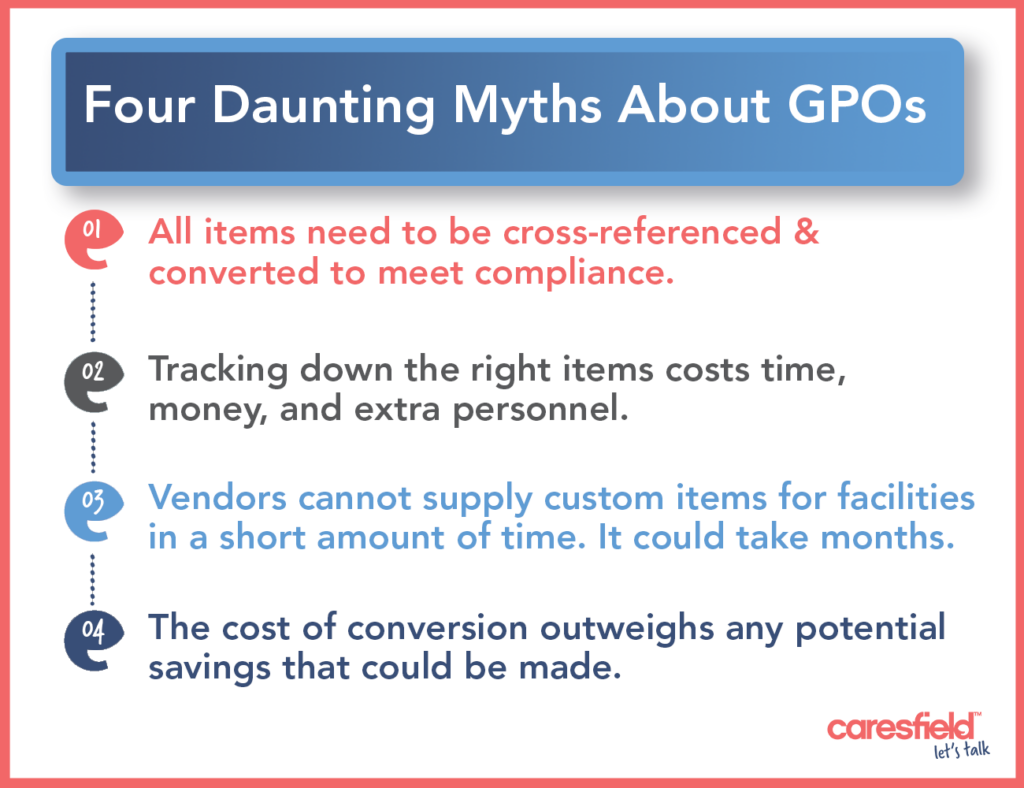
Myth 1: All items in any given category must be cross-referenced and converted to meet compliance with new GPOs.
Fact: Not every item needs to be cross-referenced and converted. Typically, in a GPO, 5-10 items make up 80-90 percent of that GPO’s annual expenses. Vendors can help hospitals and facilities determine what those items are in order to help reach the compliance goal.
Some vendors can put together a kit of the most used products and help their client make the cross-references needed to achieve compliance. Samples are used to find the best fit. In many cases, the GPO cross-references the samples themselves. Exact matches can often be made to perfectly convert one product. In the event that there is no exact match, the closest one can be provided. One GPO said that exact matches saved them 10 percent on medical-surgical supply spending, 10 percent on pharmaceutical expenses, and 20 percent for other medical device spending.
Not all changes are necessarily difficult, either. A GPO will not enforce a bad or faulty product on its members. These GPOs don’t typically rely on the lowest bidders, because of the overall cost that they must take into account.
Remember, many GPOs have members of the hospitals and facilities that they serve on their board. Communicating with your GPO will not be a complicated task.
Myth 2: In order to be compliant with GPOs, tracking down the right items costs time, money, and extra personnel.
Fact: Some contracts might not experience savings or lower costs right away. In fact, switching GPOs can lead to a brief increase in costs for a short period of time. The reason for this rise is simple: adjusting to new technology can result in mistakes, misapplications, or errors in judgment. But don’t get frustrated because you don’t see results overnight.
With the right kinds of vendors, your facility doesn’t have to spend much time or focus valuable personnel on the conversion process. The vendor themselves can collect the necessary information, perform feasibility assessments, and finalize the conversion. The vendor’s team can make sure that your new products fit both your needs and the needs of your patients. They can even help develop strategies that work when it comes to finding and using new tools on the job.
Innovation and best practices can be taught to both the suppliers and the purchasers as well during this time. The Healthcare Supply Chain Association (HSCA) President Todd Ebert said, “GPOs are expanding their offerings to meet evolving hospital and provider needs, including data analysis and benchmarking, market research, innovative technology integration, infection control, electronic product tracking, and developing and facilitating communities of knowledge among healthcare providers and supply chain experts to share best practices.”
Myth 3: Vendors cannot supply custom items for facilities in a short amount of time. It could take months.
Fact: While custom items do take longer than standard products that may already be in stock, vendors have experience providing custom solutions to their clients. GPOs don’t typically pick the lowest bidders with the lowest-quality items. Instead, they want to rely on high-quality, driven vendors who can meet the needs of their members.
Compliance is accomplished in phases. While the stocked items are replaced first, custom items will be addressed immediately afterward. Accuracy is a number one priority in matching the item and replacing it because of the complexity of the product itself.
These custom items also become difficult to find in the event of a disaster, like the COVID-19 pandemic. When such custom items cannot be made or experience a shortage, a vendor can help find a replacement.
Myth 4: The cost of conversion will outweigh any potential savings that could be made.
Fact: Not all categories are the same. Some medical categories can be simple and require little to no work in matching products and replacing them. The vendor should be able to make the change themselves without the help of the facility or with minimal help. Members won’t be called on to offer assistance unless the product is a custom product or a product that requires more technical knowledge in order to replace it correctly. In the simple categories, your facility will save money and time that can be put towards patients’ care instead.
Because of how quick the process can be with simple categories, you’ll find that savings can be immediate. Some vendors come on site to collect all these items and determine what can be replaced with little to no effort.
While the conversion process will never take place overnight, there are ways and stages to make the change easy and painless for your facility and your staff members. Not only will you save money, but you will also save time and energy in the long run.
One of the most complex categories to convert is healthcare labels and identification wristbands, but Caresfield has a proven process help your facility convert your most used items quickly so you can see immediate savings.