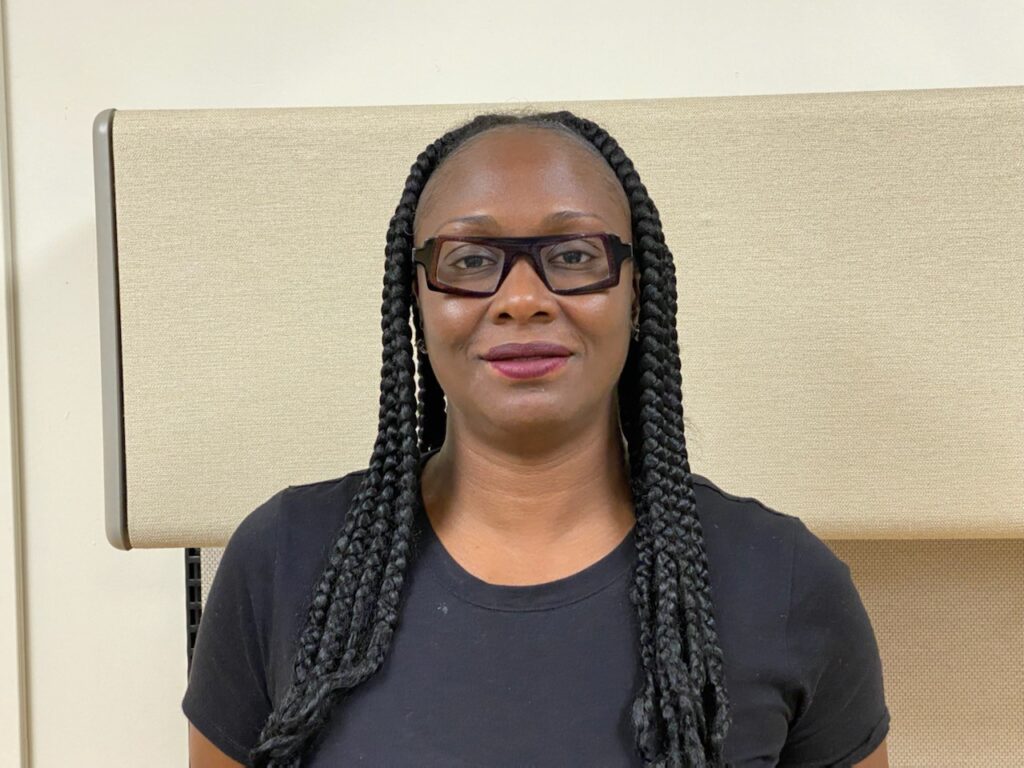
Timaka S. Wallace is an African-American nurse from Chicago. Nurse Wallace has been in the nursing field since 1996. She is currently a registered nurse, an official candidate to take the board-certified psychiatric mental health nurse practitioner exam and an adjunct professor at Augsburg University. In May 2023, she will receive her Doctorate of Nursing Practice with a concentration in Transcultural Leadership Track from Augsburg University.
In honor of Black History Month, Nurse Wallace recently took some time to chat with Caresfield. We discussed her career, the state of nursing and the challenges facing black nurses.
Now we have to get in the trenches with patients. It’s not this superficial white ivory tower – people have a lot of issues and they have a lot of problems. Following the doctor’s orders and just giving them medication at this point does not work. – Timaka S. Wallace
Can you give us an overview of your career?
I started my career here in Chicago as a certified nursing assistant. After that, I was a licensed practical nurse and then a registered nurse. In 2011, I was accepted into a graduate program in Boston to become a psychiatric nurse practitioner, which I finished in May 2020. However, I had not taken the boards yet because there was so much going on with COVID. The entire world turned upside down, and I was just exhausted.
I had already been accepted to Augsburg in 2020, not knowing that the world was going to shut down. I just pursued my doctorate degree online at Augsburg to soothe myself. As of May 2023, I will be Dr. Timaka S. Wallace.
What led you to pursue nursing?
I went into it early. I was born and raised here in Chicago. In my community, there was a free clinic at 3525 S. Michigan called the Board of Health. My grandmother would take me there for appointments, when needed, and I had a pediatric nurse — Nurse Katie.
I just loved the way Nurse Katie was with the white uniform, the hat, the little shoes. Then she would put on her blue cape coat when she was leaving work. There was something about the way Nurse Katie treated me on every visit. That’s who I saw as the person I wanted to be when I grew up. That’s the real story of why I became a nurse. I wanted to be like Nurse Katie.
What have you learned since becoming a nurse?
I learned that the nature of my job is a divine intercession. You have to have the ability to meet a person at their most vulnerable state of being. Provide the utmost sacred servitude to get them back to their highest functional ability, based on their disease process and their ability to mentally become their best version of themselves and the best version of how they will function in this new normal.
Personally, I’ve learned that nursing, healing and caring for somebody are divine servitude and intercession. It’s a reciprocating healing process. I think the patient may be getting well and somewhere in my spirit I’m able to find healing in being able to assist this person back to their holistic health.
So, we both somehow are in this process of getting back to wellness and having the mental capacity to be accepted and/or adjust to this new normal. It’s like we’re in this thing together. For me, it’s like the patient is not alone. We are both benefiting from this process as they are sick and trying to get back to normal.
What are the top challenges facing black nurses in the U.S.?
The utmost challenge facing black women in the U.S. is the challenge of us as black nurses being recognized for our contributions to the profession. We have Mary Eliza Mahoney who was the first black nurse in history to earn a professional nursing license in the United States. And then we have Dr. Rebecca Lee Crumpler. She’s the first African-American physician to be licensed as a M.D. But she was a nurse first from 1852-1860.
In 2023, as I’m completing my doctoral project, you had to pick a nurse theorist to center your project around. I found out is there are no black nurse theorists documented, ever in the history of nursing. That’s a problem for me in 2023. I have met a lot of black nurses who are Ph.D.-prepared and/or DNP-prepared that I think can be recognized and can contribute to the history of nursing. We have been here since 1800, and there are only two black nurses that we can Google. Those are the first professional nurse in the United States and the first nurse then professional medical doctor in the United States. No black nurse is listed as the first black nurse theorist or a nurse theorist at all.
Nurse Theorists
A nurse theorist is a nurse who has done her research on a particular study. They become the founder of the model in which they name. The nurse theorist that I based my study on is Madeleine Leininger. She officially birthed the Culture Care Theory of Diversity and Universality, interchangeably called the Transcultural Theory of Nursing. This is a major area of nursing that centers its attention on the affinity and analysis of various cultures and subcultures in the world with respect to the caring ethics, countenance, health-illness beliefs and even patterns of acquired behavior. Any of these things out of balance for any person can cause dis-ease in a person’s well-being ethos. They can also present as medical symptoms.
Ph.D. vs. DNP
Back in the olden days, every nurse was Ph.D.-prepared because outside of Doctoral of Nursing Scientist there weren’t any more options. Now in present-day here at Augsburg and other universities nationwide, the Doctor of Nursing Practice (DNP) has been created for nurses who do not want a Ph.D., however, we both are doctorally prepared for research and have the ability to contribute to the history of nursing.
Rosemarie Parse is my favorite theorist, she came up with the theory of Human Becoming. As a black nurse trying to figure out how to acquire a seat at the table of nursing, I called her because I felt a little unsettled as I did my research. I asked her, “Being one of the white, living nurse theorists left, how do we get black nurses to be integrated as nurse theorists; or this doctoral degree the DNP you guys have accredited nationwide? How does the research we are doing as students become a part of nursing history?”
She didn’t really have an answer. She was honest and said no one had ever really asked. Then she settled in with, “It’s not Ph.D.” I stated, “I understand that but you all voted to have another degree for nurses as a doctorate, and now you’re saying that because I’m not Ph.D.-prepared, but I have a doctorate degree it’s less than a Ph.D.-prepared?”
I’m doctorally prepared. I just did all this research, and there’s been more doctorally-prepared black nurses who I stand on the shoulders of that are Ph.D.-prepared and you say that because we’re not Ph.D.-prepared, none of our research matters? But you still give us a doctorate degree. That’s a Catch-22.
How can we overcome these challenges?
I think we need to hold the American Nurses Association accountable for change. We need them to understand that as black nurses we all go through the same schooling for whatever the degree is. We check all the boxes, so at what point do you say you can find one black nurse theorist in the world that can be added to all the white nurse theorists?
What led you to pursue teaching?
I started at Augsburg in September 2020, because COVID hit, and everything went online. Augsburg is located in Minneapolis, so the social and civil unrest were still at an all-time high due to George Floyd.
Augsburg’s nursing department wanted to start a conversation about black and white injustices and how we can get to a better place. The nursing department created a course called Dismantling White Supremacy for the nursing students. I’m a black doctoral student and we had another black doctoral nursing student. We both have master’s degrees and they didn’t have any black staff to start the conversation.
I appreciated them getting it going, but it was like an oxymoron. You created a course on Dismantling Mantling White Supremacy and you have a white person teaching? As a new student here, they asked the other black nursing doctoral student and me if we could co-lead the course. They would pay us to teach the course.
Starting the Conversation
I said yes, but I didn’t need the money. I was there on purpose at that point and I didn’t want to feel like I wanted to be controlled by the money. If we were going to have the conversation, we needed to have it and I didn’t need to be paid for anything. I did the inaugural rollout of the course and I’ve been doing it ever since. The white associate professor who was teaching it left the university. They asked me teach as an adjunct lecturer fall semester, September 2022.
I don’t teach it by myself, I teach it with Dr. Katie Clark. It’s kind of like my baby, I’ve been there since day one and it’s an amazing course. I think it’s a hard course. It gets uncomfortable, it gets heated. Students have given me feedback; I make the space warm. I show up to teach with divine intention, I make it easy to talk about hard topics and I am grateful for that.
What professional experience do you try to impart on students?
I try to impart on them to learn who the person and the soul is connected to, beyond the diagnosis written on the chart. Everyone has a story. I think that’s so important.
I think sometimes in nursing we see a chart and we see alcohol abuse, or substance abuse, and then you go in with all those biases. Then you start to treat the patient, who you don’t even know, a certain way. I think people need to know there is a story connected to every patient. Don’t go into the room or with the patient with your biases. You don’t know their story. I try to teach students to learn the story connected to the soul of the patient to the best of their ability.
What advice would you have for someone considering a future in nursing?
To be understanding and to know that we are living in a different time. Right now, if you are not a nurse trying to become a citizen nurse you are doing the profession and the patient a disservice. I learned about citizen nursing here from Dr. Katie Clark. She wrote an article on it. I had never heard of it in my life and I have been in the nursing field since
1996.
A citizen nurse is a professional nurse who assesses the world in its realistic state of being. This realistic state of being can also be known as the patient’s personal daily environment. From this standpoint, you engage with the patient, you assist on their healing journey, you execute strategies for ensuring their Maslow’s hierarchy of needs are met and you find resolutions based on case-by-case scenarios.
Go in with authentic intention on meeting the patient where they are and allowing them to be the expert of their care. You, as the professional nurse, are the collaborator. This is the only way moving forward in nursing that the true healing of mind, body and spirit will begin.
It’s nothing about coming to work and you’ve got this pretty white uniform and then you leave. Now we have to get in the trenches with patients. It’s not this superficial white ivory tower – people have a lot of issues and they have a lot of problems. Following the doctor’s orders and just giving them medication at this point does not work. You can’t put everything on the social worker; nurses have to get more involved in their patients on a holistic level for them to get well.