Wristbands are an essential part of your patient experience. From when your admissions team or nursing staff first apply an ID band until your patient heads home, these bands hold important information to help your clinicians deliver exceptional care. There are two primary methods of printing ID bands: laser sheets and direct thermal. This article will evaluate both and highlight direct thermal savings.
- Why Do Patients Wear Wristbands
- Printer Technology
- Case Study: a $50,000 Cost Savings
- Review Your Existing Printers
- Barriers to Direct Thermal Savings
- SensaBand™, Our Most Popular Direct Thermal Option
- Printer Care Program
Why Do Patients Wear Wristbands?
Patients wear wristbands at hospitals and other healthcare facilities as an identification tool. Wearing an ID band helps ensure each patient receives the proper treatment and medication. In addition, wristbands can provide visual cues for clinicians to patients who may have allergies or fall risks.

Printer Technology
There are two dominant technologies healthcare facilities use to print ID bands: laser printers and direct thermal. Laser printers work by melting toner directly on to paper. By contrast, direct thermal printers use heat to activate ink in the direct thermal paper via a printhead. Both options need specific stock for printing.
Related: Thermal Printers in Healthcare: An Overview of Best Uses, Considerations and Maintenance
Laser Bands: Not as Cheap as They Appear
There are a couple reasons healthcare facilities use laser bands. First, when you compare the cost of laser bands to direct thermal bands in a vacuum, the laser bands are almost always cheaper. In addition, you can print on different colored bands, which can serve as a visual alert. As a purchasing manager who is focused on controlling costs and protecting patient safety, laser bands seem like the obvious choice, right? Not so fast. Before you lock in a long-term solution, look deeper to see the true cost of laser bands. There are two things to keep in mind:
Toner
Toner is a finite resource and must be considered in the price for laser bands. Everything you print consumes toner and once it’s gone you need a new cartridge. If you run out of toner, there is no downtime solution. You simply won’t be able to print more bands.
Waste
In addition to the added cost of toner, there is a great deal of waste associated with laser bands. Most laser ID bands are printed on combo sheets with 20 labels. If you only need five labels, 15 are thrown away. If you need 21 labels, you’ll print an entire extra sheet for a single label. You’ll need a plan to dispose of the extra waste.
Related: 8 Healthcare ID Printer Myths Busted
Direct Thermal: No Waste
While the initial cost of direct thermal bands is normally higher, they represent the total cost. Unlike laser bands, there is no toner and very little waste.
Case Study: $50,000 Cost Savings
A recent case study of one of our clients illustrates the potential cost savings of using direct thermal for labels over laser sheets. While it’s not a perfect comparison to wristbands, it illustrates how expensive toner can be.
Our customer spent $85 per cartridge on toner with each cartridge printing 1,500 sheets. While the initial cost of the labels was cheaper for laser sheets at $562,506, compared to $716,275.80 for direct thermal, toner added $205,813.33 to the total cost. By figuring the total cost of ownership, the client gained $52,043.53 in direct thermal savings.
Curious to know how much you could save? Fill out the form below and we’ll follow up with a cost analysis!
Review Your Existing Printers
When is the last time you did a thorough review of all the printers your facility or system uses? You might be surprised to see how many options are in play. It’s not uncommon for a hospital to use both laser and direct thermal printers in different departments. Instead of ordering different SKUs for every department, you can save time and money by standardizing labels and wristbands across the system.
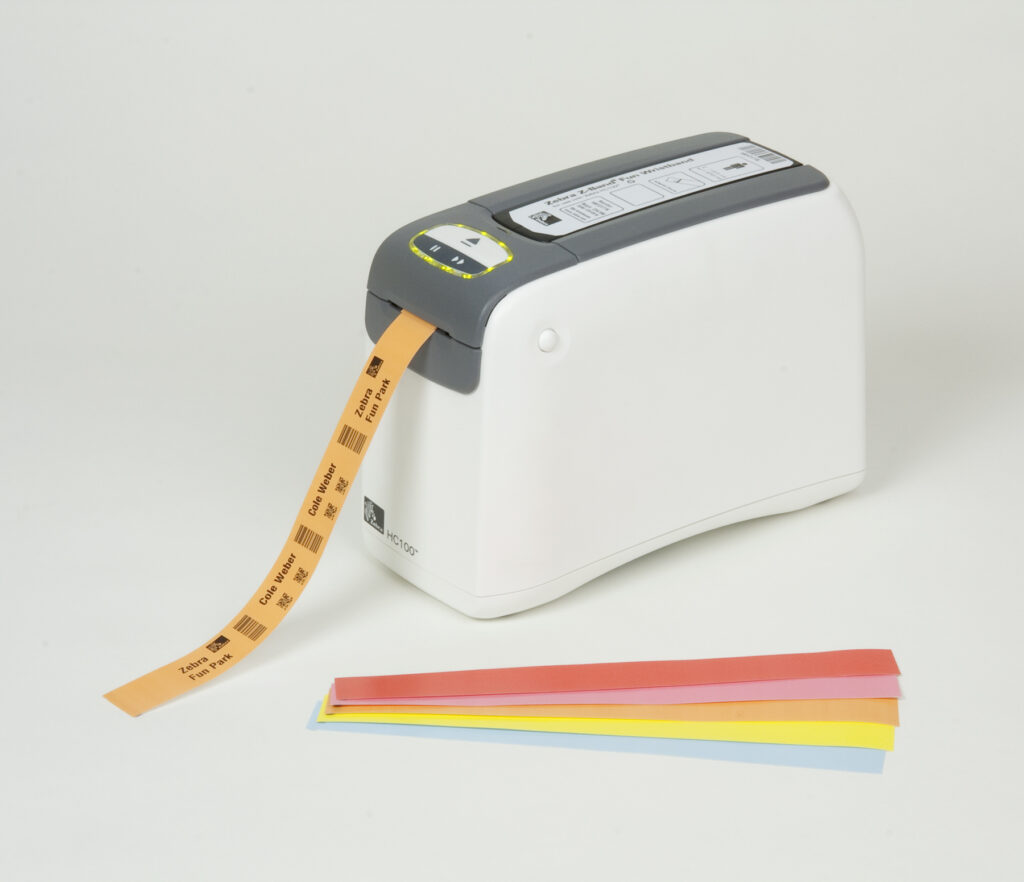
As an added benefit, direct thermal printers are usually much smaller than their laser counterparts, giving your teams more space.
Most laser printers are purchased by the facility. If you are looking to take advantage of direct thermal savings, you’ll need to get rid of the hardware. For ideas on where to dispose of your old printers, check out PC Magazine’s article How to Recycle or Donate Your Old Printer.
Barriers to Direct Thermal Savings
No matter what type of patient ID wristbands you use, Caresfield is here to help. We carry industry-leading products and national GPO contracts for both options. We know that each healthcare system is different.
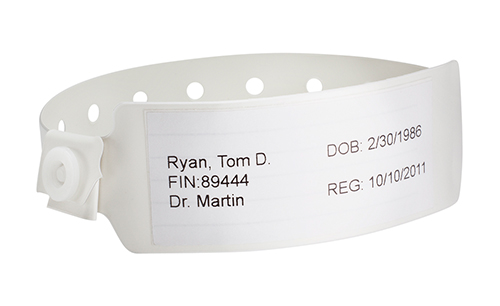
For some facilities, price is the absolute most important factor. For those facilities, write-on and insert wristbands are available. Again, beware of the hidden costs. It takes staff more staff time to write out the bands, and there is an increased chance of medical errors if a mistake is made writing information or if the writing is not legible.
We encourage our customers to utilize whichever system helps them deliver the best care. When it makes sense, we will encourage you to change your system to provide the best care. While helping customers switch from laser to direct thermal options, we’ve run into some of the same barriers. Here’ some helpful info if you are ready to make a switch:
Perceived Price Difference
As we mentioned above, many of your peers think laser bands are the most affordable solution. Oftentimes, it’s not. Make sure you track how much your organization spends on toner and how many SKUs you order for labels and wristbands. Use our form above to see if switching direct thermal makes sense for you.
IT Hesitation
Many of our customers have seen their anticipated savings from a transition to direct thermal slowed down when IT gets involved. In many cases, your technology team will worry creating new workflows and programming each printer. The good news is, we only need two bits of information from you and we can set everything up for you.
First, we need an example of a data feed. This is as simple as opening one, doing a “Save As” and sending it as a text file. Next, we will need a list of IPs for your facility. We will configure everything for you! All your team will have to do is plug it in and start printing. It’s that easy to take advantage of direct thermal savings.
SensaBand™, Our Most Popular Direct Thermal Option
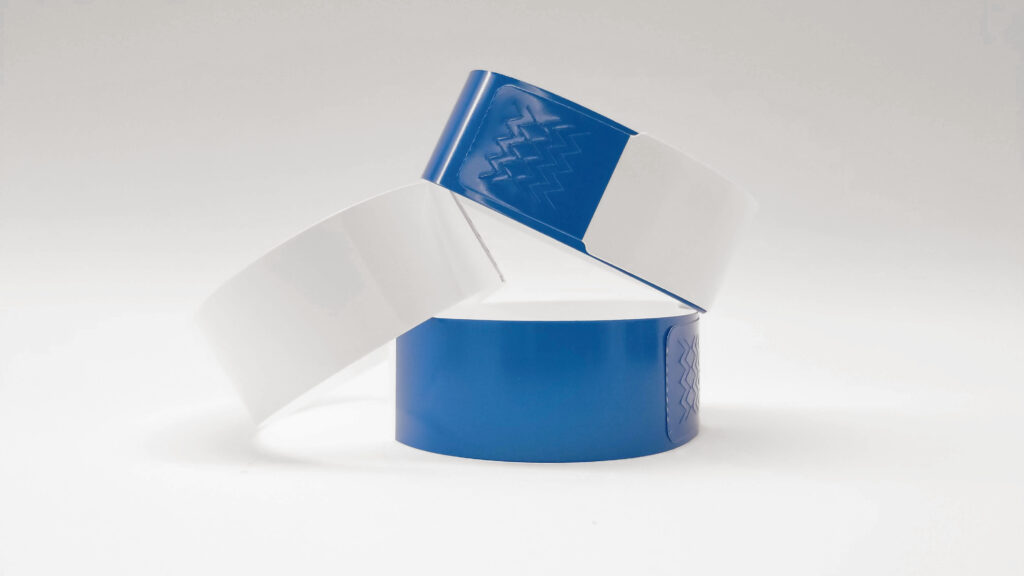
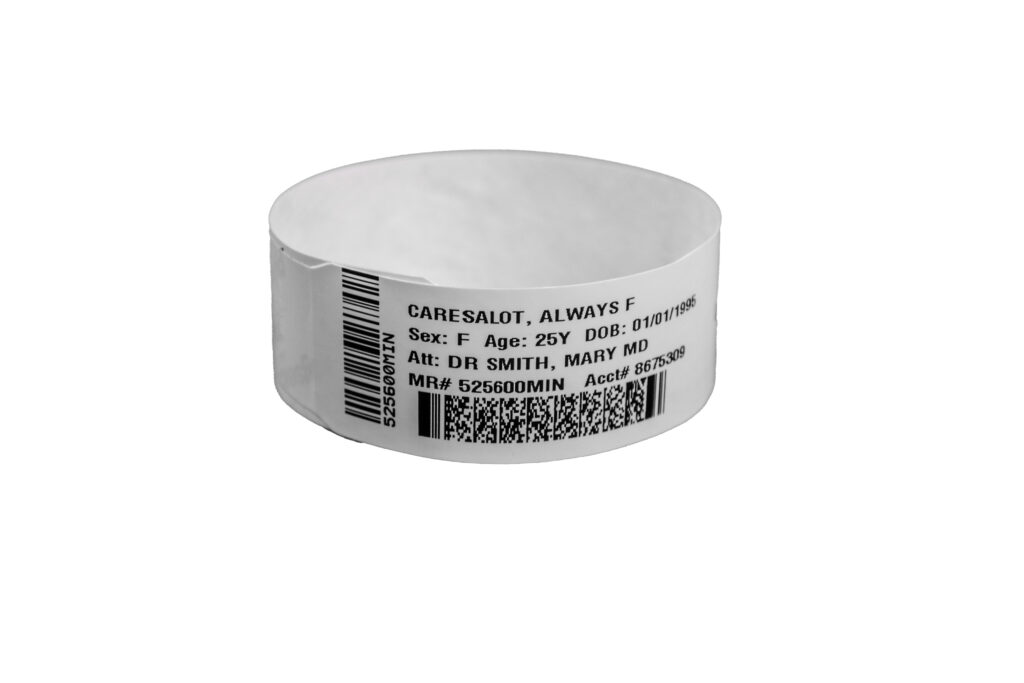
If you decide to switch to a direct thermal option, you have many options to choose from. Our most popular option is the SensaBand™. Made of extremely soft and durable Tyvek™ material, these ID bands are perfect for healthcare because of the following qualities:
- Waterproof and hand sanitizer resistant
- Natural microbial resistance
- Not made with natural rubber latex
- Works with any roll-style thermal printer
- Tamper evident adhesive closure
- Simple, patented flip-and-peel tab design
Another benefit of the SensaBand is easy customization. When you set up your printer you can tell us all the info you want included and how you would like it laid out. We’ll set up a proofing and approval process. Most of our clients approve their band design in one to two days.
To learn more about the SensaBand™, check out our CaresTalk webinar Sensaband.
Printer Care Program
Some of our customers have run into issues with direct thermal options in the past. We’ve heard of cases where a printer vendor has discontinued a model and forced the healthcare facility into an expensive upgrade. Or in other cases, the facility has upgraded printers and learned that the new model will only work with the vendor’s wristbands at a much higher price. To make it easy for you to convert to the Sensaband, Caresfield offers a Printer Care Program.
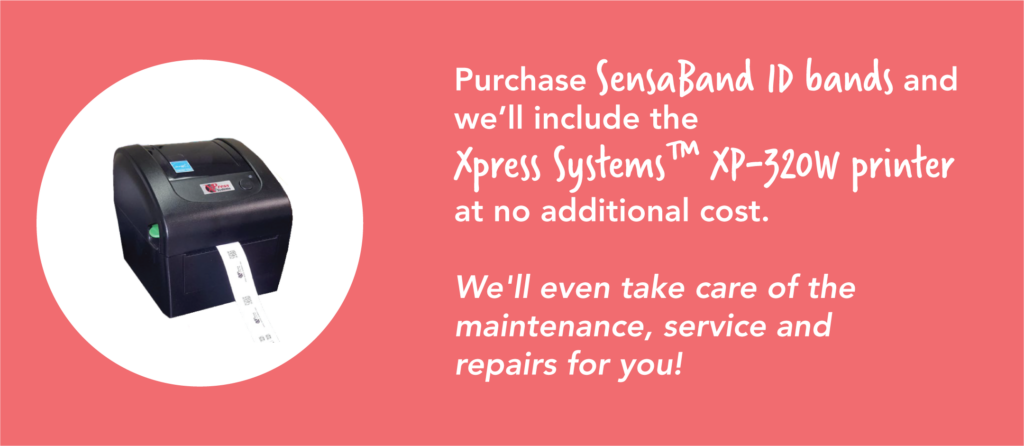
If you purchase SensaBand ID bands, we’ll include the Xpress Systems™ XP-320W printer at no additional cost. We’ll even take care of the maintenance, service and repairs for you!
Evaluate Your Wristbands Today
Need help determining which type of printers and ID bands are right for your facility? Give us a call at 952-890-7100. Our knowledgeable customer service team can help you sort through the options. You’ll talk to a real person whether you call or use the chat feature on our website. Let’s talk!